A torn ACL or other knee ligament can cause instability, swelling, and a feeling that your knee may "give way." Dr. Om Baghele provides specialist evaluation and arthroscopic ligament reconstruction for suitable cases in Gondia.
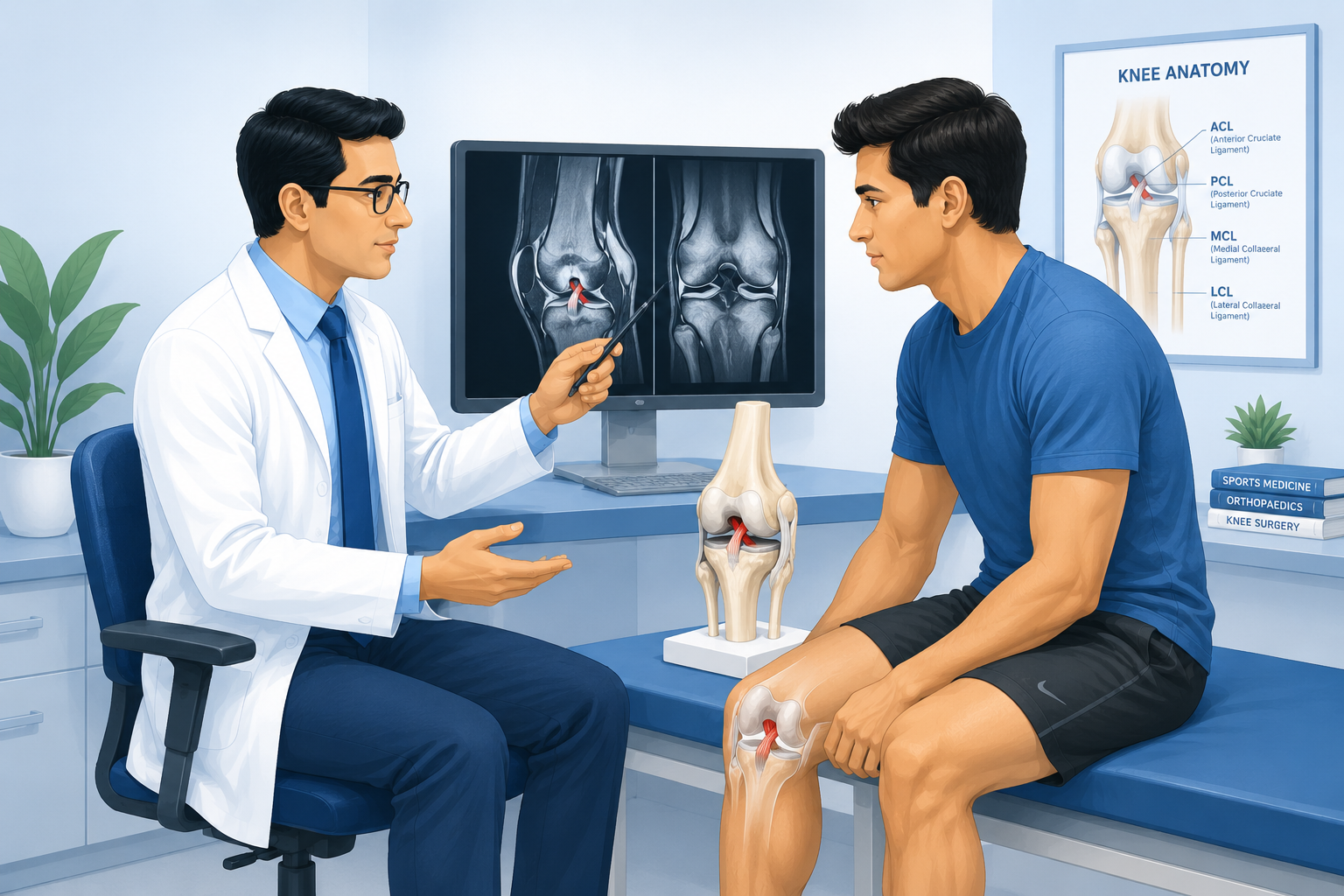
The ACL (anterior cruciate ligament) is one of the key stabilizing ligaments of the knee, commonly injured during sports, twisting movements, or sudden direction changes. When torn, it often doesn't heal on its own - reconstruction surgery replaces the torn ligament with a graft, restoring stability to the joint. This is typically performed arthroscopically, through small incisions.
Not every ligament injury needs reconstruction. Younger, active patients and those with significant instability are more likely to benefit from surgery, while some patients - particularly those with lower activity demands - can be managed with structured physiotherapy and bracing. Dr. Om will assess your specific injury, activity level, and goals before recommending a path.
ACL and ligament reconstruction is performed arthroscopically - a minimally invasive, camera-guided technique that allows precise graft placement through small incisions, supporting a more comfortable recovery than open surgery.
Recovery from ligament reconstruction is a structured, staged process - early movement and swelling control, followed by progressive strengthening, and eventually a graded return to sport or activity. Timelines vary by patient and the specific procedure performed, and rushing return-to-sport too early increases re-injury risk.
Rest, ice, and elevation. Gentle movement begins with physiotherapy support.
Crutches phased out. Strengthening exercises ramp up steadily.
Walking normally. Light jogging introduced as strength returns.
Sport-specific drills and agility work begin under guidance.
Return to competitive sport once strength and stability are confirmed.
A complete ACL tear typically does not heal on its own - the ligament lacks the blood supply needed for natural repair. Partial tears or injuries in less active patients may be managed without surgery, but the knee often remains unstable. Dr. Om will assess the severity and your goals before recommending any path.
As soon as possible. Seeing a specialist early allows accurate diagnosis - often with an MRI - and helps distinguish a complete tear from a partial one or other knee injury. Early assessment does not commit you to surgery; it clarifies your options.
ACL reconstruction is performed arthroscopically - through small incisions - under general anaesthesia. It is not open surgery, but it does require careful post-operative rehabilitation. Most patients are admitted for one night and begin physiotherapy within days.
Most patients return to competitive sport between 9 and 12 months after ACL reconstruction. Returning too early significantly increases re-injury risk, so Dr. Om and your physiotherapist will guide the timeline based on strength and stability testing.
Whether you recently injured your knee or continue to experience instability, a specialist assessment can help determine the right treatment path.