Arthroscopy is a minimally invasive surgical technique that uses a small camera to look inside a joint and treat problems through tiny incisions. Dr. Om Baghele uses arthroscopic methods to diagnose and treat knee conditions - including ACL tears, meniscus injuries, and cartilage damage - with less disruption and faster recovery than open surgery.
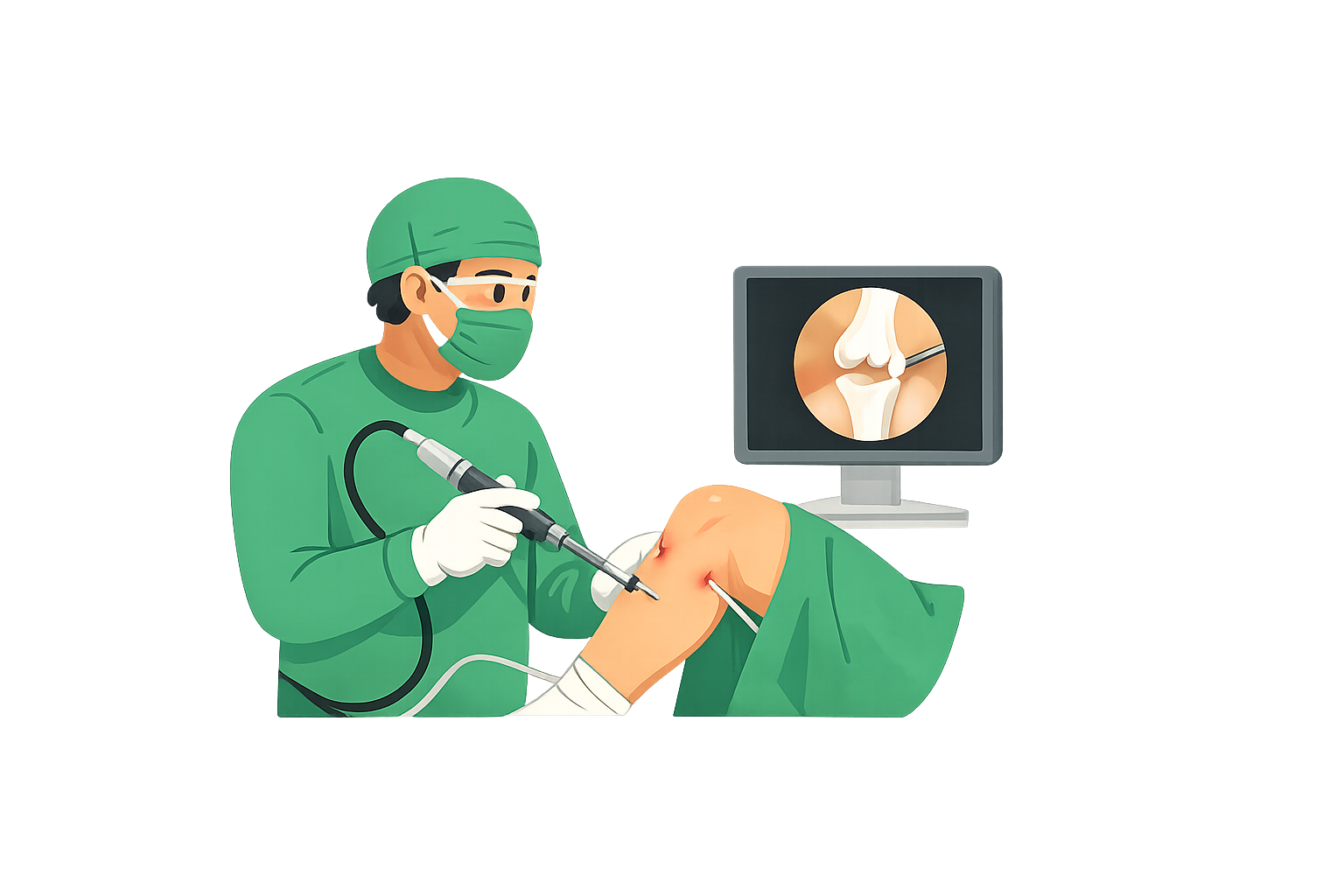
Arthroscopy uses a thin, pencil-sized instrument called an arthroscope - fitted with a tiny camera and light source - inserted into the joint through a small incision. The camera transmits images to a monitor, allowing the surgeon to see the joint interior in real time without opening it fully. Surgical instruments are passed through separate small incisions to perform the repair.
Compared to open surgery, arthroscopy involves less cutting of surrounding tissue, less post-operative pain, a lower infection risk, and a faster return to mobility.
Two or three portal incisions, each less than 1 cm, are made around the joint under general or regional anaesthesia.
The camera is guided into the joint. Live images are projected onto a monitor, giving the surgeon a detailed view of all structures.
Surgical instruments are introduced through separate portals to trim, repair, or remove damaged tissue as needed.
The portals are closed with small sutures or steri-strips. The procedure typically takes 30–90 minutes depending on findings.
Recovery depends on what was treated. Diagnostic or minor procedures allow faster return to activity; complex repairs like ACL reconstruction require a structured rehabilitation programme over several months.
Walking with support begins. Ice and elevation to manage swelling.
Wound review. Physiotherapy starts with gentle range-of-motion exercises.
Return to light daily activities for most procedures. Strength building progresses.
Full functional recovery for complex repairs. Sport-specific training resumes.
Return to competitive sport after ligament reconstruction once stability is confirmed.
No. Arthroscopy is performed through two or three small incisions of less than 1 cm. Open surgery requires a much larger incision that exposes the joint directly. Arthroscopy causes less tissue damage, less post-operative pain, and typically allows faster recovery.
Most arthroscopic procedures take between 30 and 90 minutes depending on what is being treated. Diagnostic arthroscopy is typically shorter; ACL reconstruction or complex meniscus repair takes longer. Most patients are admitted for one night or treated as a day case.
Arthroscopy is used to treat ACL and ligament tears, meniscus tears (trimming or repair), cartilage damage, removal of loose bodies, and inflamed joint lining (synovitis). It can also be used for diagnosis when MRI results are unclear.
Recovery depends on the procedure. Minor arthroscopy such as loose body removal allows return to light activity within a few weeks. ACL reconstruction requires 9–12 months of rehabilitation before return to competitive sport. Dr. Om will give you a personalised recovery plan before surgery.
An accurate diagnosis is the first step. Book a consultation with Dr. Om Baghele to find out whether arthroscopy is the right option for your knee condition.